

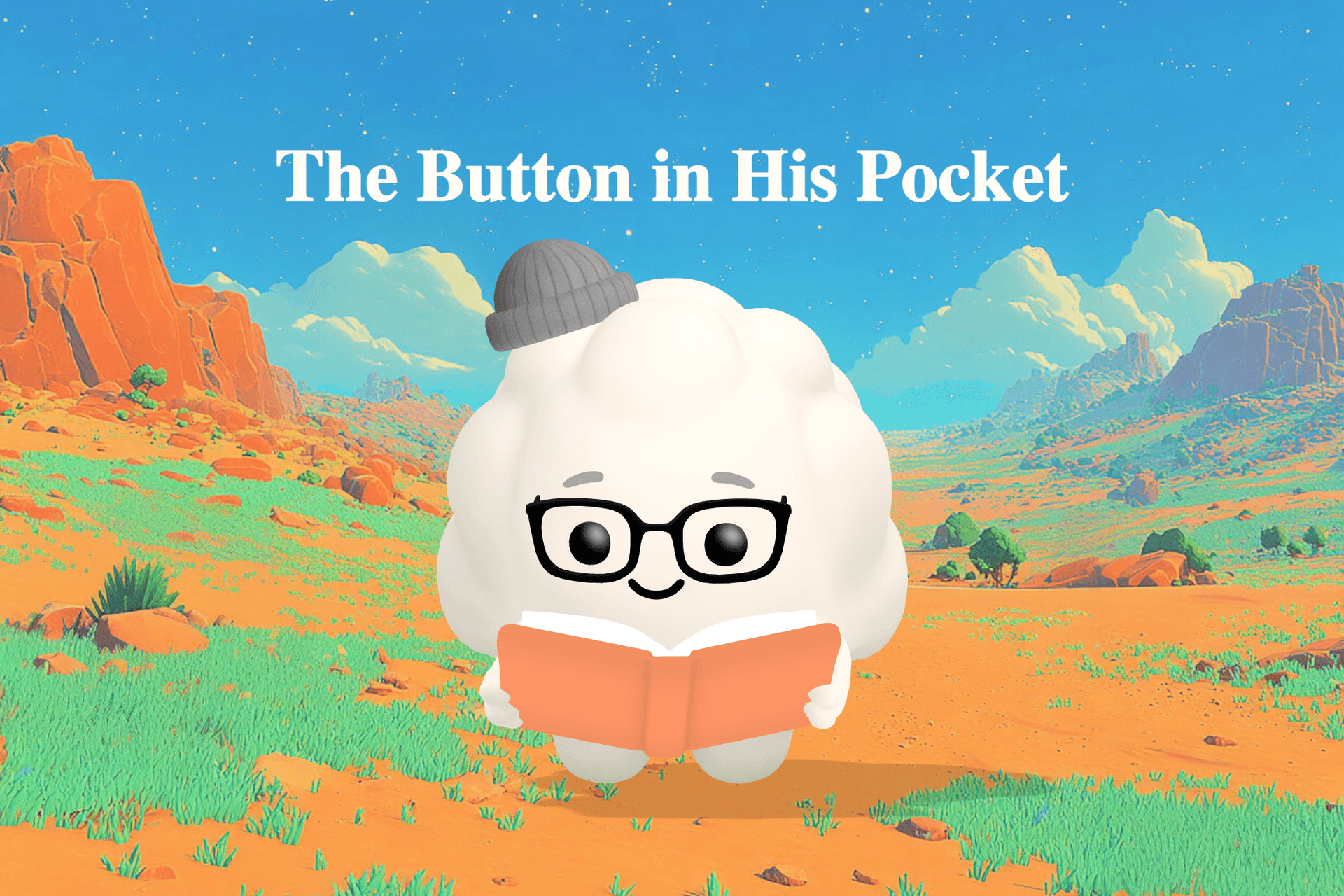
There is something about the moment a child lets go of your hand that stays with you long after the school door closes. In The Button in His Pocket, a little koala named Pip clings to his mama's coat until she presses a small brown button into his palm, and slowly, through paint and laughter, he discovers he can be brave on his own. It is one of the most heartfelt short stories about separation anxiety we have found, and it makes a perfect bedtime read for little ones facing big feelings. If your child connects with Pip's story, you can create a personalized version starring them with Sleepytale.
Why About Separation Anxiety Stories Work So Well at Bedtime
Bedtime is often when worries about the next day creep in, especially for children who struggle with being apart from the people they love. A story about separation anxiety read at night gives kids a safe space to name those feelings before sleep. When a character like Pip faces the same tight, uncertain feeling in his chest, children realize they are not alone in what they feel, and that recognition alone can be deeply calming. What makes these stories especially powerful at bedtime is the gentle arc from fear to comfort. Children do not need to be told everything will be fine; they need to see someone small and unsure find their footing one moment at a time. Pip's button is not magic, but it carries the warmth of connection, and that quiet reassurance is exactly what a child needs before closing their eyes.
The Button in His Pocket
Pip had never let go.
Not once.
Not for breakfast, not for bath time, not even when Mama reached up to pull a jar from the high shelf and he had to tilt sideways with her.
He held on.
His small claws curved around the grey fur of her back like they belonged there, like they had grown that way on purpose.
And maybe they had.
Mama never complained.
She hummed while she walked, a low rolling sound that Pip could feel in his chest before he could hear it with his ears.
She smelled like eucalyptus and something warmer underneath, something that had no name but that Pip knew the way he knew his own heartbeat.
But school was coming.
It had been coming for weeks, the way a storm comes, slow and then suddenly very close.
The night before, Mama laid out his backpack on the floor.
Blue, with a zipper that stuck a little.
She packed a sandwich cut into triangles, a juice box, and a folded drawing of the two of them that she had made herself.
She was not a very good artist.
The ears were too big and the arms too short, but Pip pressed it flat and put it in the front pocket anyway.
He did not sleep much.
He lay on her back in the dark and counted her breaths.
Twelve.
Thirteen.
Fourteen.
At some point the counting became dreaming, and the dreaming became morning, and morning meant it was time.
The school smelled like paint and rubber and someone's forgotten banana.
Pip stood at the gate.
His claws were still hooked into the back of Mama's coat, bunching the fabric.
Other children walked past.
A wombat with red boots.
Two small possums arguing about something.
Nobody was holding on the way Pip was holding on.
Mama turned around slowly, careful not to tip him.
She crouched down until they were eye to eye.
"I have to go to work," she said.
Not sorry, not in a way that made it worse.
Just true.
Pip's chin went stiff.
"I know," he said.
He did not know.
She reached up to the collar of her jacket.
There was a button there, round and dark brown, the color of river mud.
She worked it loose with two fingers, patient and unhurried, and then she pressed it into Pip's palm and closed his fingers around it.
"Hold this when you miss me."
It was smooth on one side and had four little holes in the middle.
It was not special.
It was just a button.
But it was warm from her coat, and that was something.
He squeezed it once before she reached the corner.
Twice when the classroom door closed behind him.
The teacher, a tall echidna named Mr.
Barrow, showed everyone where to hang their bags.
Pip squeezed the button a third time and a fourth.
Morning circle.
A song about the days of the week.
Pip mouthed the words and squeezed the button on the hard parts.
By the time they moved to reading, he had squeezed it seven times.
He kept count in his head the way he had counted Mama's breaths.
The wombat in the red boots sat next to him.
Her name was Bette.
She leaned over and looked at his book, then at him.
"Do you know what sound the letter G makes?"
she asked.
"Two sounds," Pip said.
Bette looked impressed.
"Two?"
"Like in 'go.'
And like in 'giraffe.'" She thought about this for a long moment.
Then she said, "I only knew one," and went back to her book, but she moved her chair a little closer to his.
Snack time.
Pip ate half his sandwich and squeezed the button two more times.
Eleven total.
He put it back in his pocket.
After snack, Mr.
Barrow pushed back the tables and spread paper across the floor.
Big sheets, the kind that crinkled when you touched them.
He set out jars of paint, the thick kind that smells sharp and leaves a ring on your fingers even after you wash them.
Red, yellow, blue, green, and one jar of orange that was almost empty.
Pip stood at the edge of the paper and looked at it.
"You can start anywhere," Mr.
Barrow said.
He was already crouched down, making a long green stripe with his whole arm.
Pip picked up a brush.
He dipped it in the blue.
He was not sure what he was painting.
He started with a circle, then another, then something that might have been a tree or might have been a cloud.
Bette was next to him, making what she said was a horse but looked more like a table with feelings.
She said this herself and laughed, and Pip laughed too, and then he made a table with feelings of his own and they laughed again.
The orange was almost gone but he got enough for the sun.
He pressed the brush flat to get the last of it and made a wide, uneven arc in the corner of his paper.
Somewhere between the cloud and the sun, he stopped counting.
He did not notice when it happened.
There was no moment he could point to.
One minute the button was a thing he was thinking about, and then it was just a thing in his pocket, and then he was not thinking about his pocket at all.
He was thinking about whether blue and yellow really did make green, because he had heard that but never tried it, and he was trying it now, and they did.
They really did.
Mr.
Barrow put on music while they cleaned up.
Something with a lot of brass instruments that made Bette stomp her red boots on the floor.
Pip rinsed his brush three times until the water ran clear.
He had paint on his elbow and he did not know how.
When Mama appeared in the doorway at the end of the day, Pip was still looking at his painting, which Mr.
Barrow had clipped to the drying line with a wooden peg.
She looked tired.
There was a coffee stain on her sleeve that had not been there this morning.
She scanned the room until she found him, and something in her shoulders came down.
Pip walked to her.
He did not run.
He walked, because he was someone who had spent a whole afternoon painting and learning that blue and yellow make green and laughing at a table with feelings.
He put his arms around her middle and pressed his face into her coat.
She put her chin on top of his head.
"How many times?"
she asked.
She already knew about the button.
She had known before she gave it to him.
"Eleven," he said into her coat.
"Before lunch."
"And after?"
He thought about it.
He reached into his pocket.
The button was still there, smooth and round and cool now, just a button.
"I forgot," he said.
Mama made a sound that was not quite a laugh and not quite something else.
She held him a little tighter.
Outside, the last of the afternoon light was flat and gold across the pavement.
Bette waved from the gate, her red boots flashing.
Pip waved back.
He climbed up onto Mama's back, and her coat smelled like her coat, and they walked home.
The Quiet Lessons in This About Separation Anxiety Bedtime Story
This story gently explores the themes of courage, connection, and the slow discovery of independence. When Pip squeezes the button eleven times before lunch and then forgets it entirely while mixing blue and yellow paint, children see that bravery is not the absence of fear but the willingness to keep going anyway. Bette's small act of moving her chair closer also shows that friendship can begin with something as simple as sharing what you know. These lessons settle in softly at bedtime, when a child's mind is open and reflective.
Tips for Reading This Story
Give Mama a low, steady voice full of warmth, especially when she says “Hold this when you miss me,“ and pause just a beat before Pip closes his fingers around the button. Speed up slightly and let your voice lift during the painting scene when Pip and Bette laugh about their “tables with feelings.“ When Pip tells Mama he squeezed the button eleven times, slow way down and read his quiet “I forgot“ almost in a whisper.
Frequently Asked Questions
What age is this story best for?
This story works beautifully for children ages 3 to 7, especially those preparing for or adjusting to school, daycare, or any new setting away from a caregiver. The counting of button squeezes gives younger listeners a concrete, comforting detail to follow, while older children will connect with the moment Pip realizes he simply forgot to be afraid.
Is this story available as audio?
Yes, you can listen to the audio version by pressing play at the top of the page. Hearing Mama's calm, unhurried voice as she works the button loose from her collar is especially soothing in audio form, and the scene where Pip and Bette laugh over their painted tables with feelings comes alive with warmth when read aloud.
Why does Pip's mama give him a plain button instead of something more special?
That is part of what makes the story so honest and moving. The button is not magical or rare; it is just a plain brown button from her coat collar, warm because she was wearing it. The simplicity teaches children that comfort does not have to come from something grand; it can live in the smallest, most ordinary object, as long as it carries love.
Create Your Own Version
Sleepytale turns your child's own worries and wonders into a personalized bedtime story they can hear again and again. You can swap the koala for your child's favorite animal, replace the button with a special object they already treasure, or set the story at their very own school. In just a few moments, you will have a cozy, calming tale that feels like it was written for your family alone.
Looking for more social stories for kids?
Stories About Losing A Tooth
A stubborn tooth finally pops out into mashed potatoes at dinner in one of our favorite short stories about losing a tooth.
Stories About Getting Glasses
Explore short stories about getting glasses where a boy named Elliot sees his mom's freckles for the very first time.
Stories About Changing Schools
A yellow sticky note with a crooked map leads to real friendship in short stories about changing schools for bedtime.
Stories About Missing A Parent
Ever wonder if short stories about missing a parent could comfort your child the way Nora wraps herself in her dad's old sweatshirt.
Stories About Deployed Parent
Discover short stories about deployed parent love through Oliver, who plays his mom's recorded voice a pillow until the house feels right again.
First Day Of Daycare Stories
Milo's plan was simple: do not cry. Discover short first day of daycare stories where a wobbly block tower changes everything.